
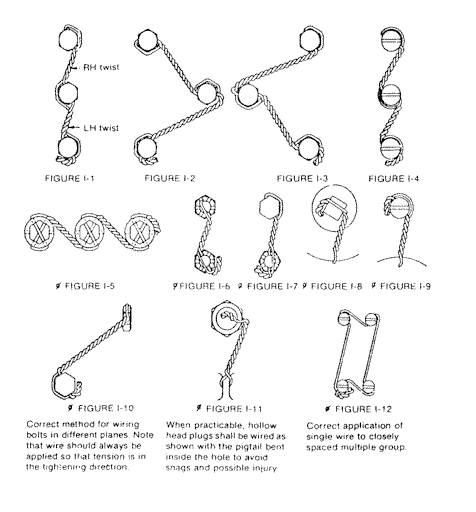
Installing lock wire across critical threaded fasteners provides positive mechanical locking that prevents bolts from backing out under severe vibration and thermal cycling. In high-performance environments like aviation, motorsport, and industrial machinery, standard thread-locking compounds or lock washers often fail to withstand extreme operating conditions. Incorporating safety wiring into your assembly standards ensures joint integrity, eliminates catastrophic hardware failures, and maintains mechanical reliability.
How Lock Wire Prevents Critical Fastener Failure in Extreme Environments
Understanding how lock wire prevents critical fastener failure requires analyzing the physical forces acting on bolted joints. When machinery operates at high RPMs or under intense harmonic vibration, threaded fasteners naturally experience micro-movements. Over time, these small rotational forces overcome friction, causing un-torqued bolts to back out completely.
Safety wiring counteracts this rotational movement by tying two or more fasteners together in a state of positive tension. If a bolt attempts to loosen counterclockwise, the attached wire tightens and applies a direct clockwise pulling force on the adjacent fastener. This mechanical counter-tension physically locks the assembly in place, guaranteeing that hardware remains torqued even if primary clamp load drops.
Comparing Mechanical Locking Methods
While chemical threadlockers and mechanical washers have their place, positive wire locking remains the gold standard for mission-critical joints.
| Locking Mechanism | Primary Action | Temperature Limit | Visual Inspection | Reusability |
| Safety Lock Wire | Positive mechanical tension tie | Up to 2,000°F (Stainless/Inconel) | Immediate visual verification | Wire replaced per maintenance |
| Chemical Threadlocker | Anaerobic adhesive bond | Typically 300°F to 450°F | Requires disassembly to inspect | Requires reapplication |
| Prevailing Torque Nuts | Thread friction deformation | Varies by insert material | Difficult to verify visually | Limited cycle life |
| Split Lock Washers | Spring tension friction | High (metal-dependent) | Moderate visual check | Single-use recommended |
Technical Specifications and Material Selection of a Wire Lock
Selecting the proper wire lock diameter and material alloy is essential to ensure maximum shear strength without causing wire fatigue or breakage during installation.
Popular Wire Alloys
- Stainless Steel (Type 302/304): The standard choice for aviation and industrial applications. Offers high corrosion resistance, excellent ductility, and reliable tensile strength up to 800°F.
- Inconel 600 / 625: Essential for high-heat environments like exhaust manifolds, turbine housings, and aerospace propulsion systems operating above 1,200°F.
- Monel (Nickel-Copper Alloy): Specified for marine hardware and subsea equipment requiring extreme saltwater corrosion resistance.
- Brass: Used in specialized electrical applications or non-magnetic environments where sparking must be prevented.
Standard Wire Gauges and Applications
- 0.020 inch (0.51 mm): Used for small, closely spaced fasteners, electrical connectors, and delicate engine sensors.
- 0.032 inch (0.81 mm): The primary industry standard for standard bolt heads, oil drain plugs, and structural fasteners.
- 0.041 inch (1.04 mm): Applied to heavy-duty industrial bolts, large driveshafts, and high-stress structural joints requiring maximum tensile strength.
Proper Installation Techniques for Lock Wire Bolts
Securing lock wire bolts correctly requires precision tool handling and adherence to strict mechanical geometry rules. A poorly installed safety wire offers zero mechanical resistance and can create dangerous debris if the wire snaps.
Step-by-Step Installation Best Practices
- Drill Hole Alignment: Ensure safety wire holes are clean, burr-free, and oriented so the wire exits toward the tightening direction of the next bolt.
- Maintain Correct Pull Direction: The wire must always pull the bolt head in the clockwise (tightening) direction. Never loop the wire in a way that allows counterclockwise movement before tension engages.
- Twists Per Inch (TPI): For standard 0.032 inch stainless steel wire, apply 6 to 8 twists per inch using dedicated safety wire pliers. Under-twisting weakens the assembly, while over-twisting work-hardens the wire and leads to brittle failure.
- Pigtail Termination: Finish every lock wire run with a 1/2-inch to 5/8-inch twisted pigtail (3 to 6 twists), then fold the sharp end neatly inward toward the component body to prevent snagging or injury.
Incorrect Wire Routing (Counter-Tension Pulls Loose):
[Bolt 1] <— (Loosening Pull) <— [Wire] <— [Bolt 2]
Correct Wire Routing (Positive Tightening Lock):
[Bolt 1] —> (Tightening Pull) —> [Wire] —> [Bolt 2]
Single-Wire vs Double-Twist Patterns
- Double-Twist Method: The standard multi-bolt locking method. Two strands of wire are twisted together between fasteners, providing maximum strength and redundancy.
- Single-Wire Method: Permitted only on small, closely spaced bolt patterns, electrical fittings, or hard-to-reach locations where double-twisting is physically impossible.
Quality Control and Visual Inspection Criteria
One of the greatest operational advantages of safety wiring is instant visual verification. Technicians and quality inspectors can audit a bank of fasteners in seconds without needing a torque wrench.
Common Defects That Fail Inspection
- Reverse Pulling: The wire pulls the bolt head counterclockwise, actively helping the fastener loosen under load.
- Slack Wire: Excessive droop or looseness between bolts allows the fastener to rotate several degrees before wire tension engages.
- Nicked or Over-Twisted Strands: Deep tool marks from pliers create stress risers that snap under severe engine vibration.
- Exposed Sharp Ends: Pigtails left sticking straight out pose serious hazards to maintenance personnel working in tight engine bays.
Integrating safety lock wire into your mechanical assemblies is an unmatched strategy for preventing fastener backing, structural joint separation, and catastrophic equipment damage. By selecting the correct wire gauge, matching alloy properties to operational temperatures, and applying proper double-twist installation techniques, engineering teams guarantee maximum joint security. Whether servicing aircraft systems, race vehicles, or heavy industrial machinery, positive wire locking remains the definitive defense against vibration-induced fastener failure.